
Introduction:
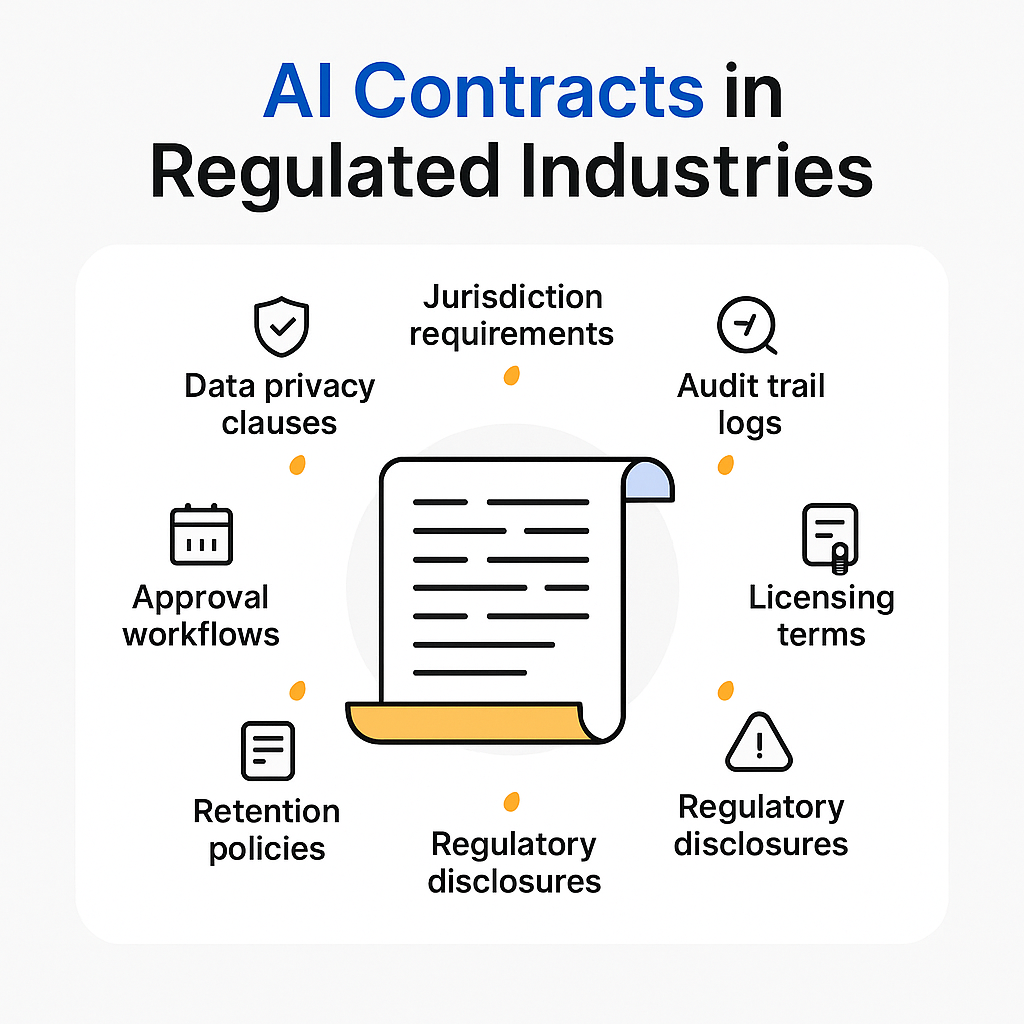
Artificial intelligence (AI) deployments in regulated sectors demand rigorous contractual safeguards. Whether integrating a vendor’s AI service or building AI models in-house, organizations in healthcare, financial services, government/public sector, and critical infrastructure must navigate complex compliance requirements. The stakes are high – data misuse or biased algorithms can trigger legal penalties, reputational damage, or even direct customer harm. A clear, well-negotiated AI contract is a critical risk management tool. It ensures the AI system operates within the bounds of laws like HIPAA, GDPR, the forthcoming EU AI Act, GLBA, and other relevant regulations. It sets expectations for data handling, transparency, security, and accountability. This article guides CIOs and procurement leaders on key considerations when contracting for AI in regulated industries. These include vendor vs. in-house AI, essential contract clauses, sector-specific regulations, pitfalls to avoid, and risk mitigation strategies.
Vendor-Provided vs. Internally Built AI Systems
Contracts and governance will differ depending on whether the AI solution is procured from a third-party vendor or developed internally. In both cases, compliance and accountability must be assured, but the approach varies:
- Vendor-Provided AI: A formal contract is the primary mechanism to impose obligations when using an external AI vendor. The contract should require the vendor to comply with all applicable laws and industry regulations. It must clearly define responsibilities, performance standards, and liability. Before signing, diligence on the vendor’s compliance record, financial stability, and security posture is essential. Vendor agreements should also be reviewed for third-party components (e.g., if the vendor’s AI relies on another company’s model like OpenAI via API) – ensure those dependencies and their terms are disclosed and passed through in the contract. Ultimately, with third-party AI, you will rely on contractual terms to protect your interests, since the vendor controls the technology.
- Internally Built AI: In-house AI development shifts responsibility entirely onto the enterprise. There may be no vendor contract to enforce compliance, but internal policies and procedures should codify the same principles. Organizations should establish internal “contracts” through governance frameworks: e.g., data handling protocols, model validation processes, and audit trails to demonstrate compliance. Building AI in-house does not bypass regulation – for example, a hospital building its diagnostic AI must still meet HIPAA and FDA requirements as if it were a vendor product. Internal projects should undergo rigorous risk assessments similar to vendor due diligence, and management must assign clear accountability for maintaining regulatory compliance, model quality, and security throughout the AI’s lifecycle. In practice, many internally built systems still incorporate vendor tools or cloud services (for infrastructure or pre-trained models), so procurement may still be involved at component levels (with contracts for cloud platforms, data sources, etc.). Ensure all such agreements include appropriate protections (for instance, if using a cloud ML service to train an internal model, that cloud provider should sign a BAA for PHI or a Data Processing Addendum for personal data, as required).
Both approaches require alignment with compliance – the difference is that with vendors, you enforce it via contract, and with internal projects, you enforce it via governance and possibly contracts with supporting service providers. In either case, document everything (contracts or internal policies) to prove due diligence. Regulators expect that the organization will take steps to ensure its AI is compliant and ethical, whether or not a third party is involved.
Regulatory Landscape by Industry
AI in regulated industries is subject to sector-specific laws and global regulations. Below is an overview of key regulations in healthcare, finance, government, and critical infrastructure, and how they affect AI usage and contracts:
| Regulation/Law | Relevant Sector | AI Contract Implications |
|---|---|---|
| HIPAA (USA) – Health Insurance Portability and Accountability Act | Healthcare (patient data privacy) | Imposes broad obligations on processing personal data, affecting AI globally. If an AI vendor processes EU personal data on your behalf, you must have a Data Processing Agreement ensuring the vendor: (a) only processes data per your instructions; (b) uses adequate security; (c) assists with individuals’ rights (access, deletion, etc.); and (d) allows audits. GDPR’s Article 22 also gives individuals rights regarding automated decisions – for high-impact AI decisions (e., credit approval), contracts may need to ensure the system provides meaningful explanations or human review on request. Data localization or approved cross-border transfer mechanisms (like Standard Contractual Clauses) should be addressed if the AI provider is offshore. Non-compliance can lead to severe fines (up to 4% of global turnover). Italy’s data regulator even temporarily banned ChatGPT over GDPR concerns about unlawful data collection for training, illustrating that generative AI must be By lawd for privacy compliance. |
| GDPR (EU) – General Data Protection Regulation | Any sector (personal data) | High-risk AI in various sectors (e.g., healthcare devices, credit scoring, public service AI) |
| EU AI Act (EU) – (Pending legislation) | Governs the protection of consumers’ financial information. Bylaw, financial institutions must use strict controls with service providers to safeguard customer data. When outsourcing AI to handle account data or transaction info, the vendor must implement and maintain appropriate security measures (e.g., encryption, access controls) and comply with privacy requirements. The contract should also cover the vendor’s compliance with their obligations under any specific financial data regulations (for instance, if the AI processes credit data, ensure Fair Credit Reporting Act or Equal Credit Opportunity Act considerations are addressed – e.g., the ability to provide adverse action reasons). Regulators like the U.S. OCC and Federal Reserve also expect banks to apply model risk management to AI models. Thus, contracts might include provisions for the vendor to provide model details or assist in validation. | Governs the protection of consumers’ financial information. By law, financial institutions must use strict controls with service providers to safeguard customer data. When outsourcing AI to handle account data or transaction info, the vendor must implement and maintain appropriate security measures (e.g., encryption, access controls) and comply with privacy requirements. The contract should also cover the vendor’s compliance with their obligations under any specific financial data regulations (for instance, if the AI processes credit data, ensure Fair Credit Reporting Act or Equal Credit Opportunity Act considerations are addressed – e.g., the ability to provide adverse action reasons). Regulators like the U.S. OCC and Federal Reserve also expect banks to apply model risk management to AI models. Thus, contracts might include provisions for the vendor to provide model details or assist in validation. |
| Governs the protection of consumers’ financial information. Bylaw, financial institutions must use strict controls with service providers to safeguard customer data. When outsourcing AI to handle account data or transaction info, the vendor must implement and maintain appropriate security measures (e.g., encryption, access controls) and comply with privacy requirements. The contract should also cover the vendor’s compliance with their obligations under any specific financial data regulations (for instance, if the AI processes credit data, ensure Fair Credit Reporting Act or Equal Credit Opportunity Act considerations are addressed – e.g., the ability to provide adverse action reasons). Regulators like the U.S. OCC and Federal Reserve also expect banks to apply model risk management to AI models. Thus, contracts might include provisions for the vendor to provide model details or assist in validation. | Financial services (banks, insurers, investment firms) | Governs the protection of consumers’ financial information. By law, financial institutions must use strict controls with service providers to safeguard customer data. When outsourcing AI to handle account data or transaction info, the vendor must implement and maintain appropriate security measures (e.g., encryption, access controls) and comply with privacy requirements. The contract should also cover the vendor’s compliance with their obligations under any specific financial data regulations (for instance, if the AI processes credit data, ensure Fair Credit Reporting Act or Equal Credit Opportunity Act considerations are addressed – e.g., the ability to provide adverse action reasons). Regulators like the U.S. OCC and Federal Reserve also expect banks to apply model risk management to AI models. Thus, contracts might include provisions for the vendor to provide model details or assist in validation. |
| Sectoral Laws & Standards – (Various) | Healthcare: FDA software regulations, EU MDR; Finance: SOX, Basel/FFIEC guidelines; Energy/Telecom: NERC CIP, NIS2 (EU), etc.; Public Sector: Privacy Act, algorithmic transparency laws | In healthcare, if an AI system is used for diagnosis or treatment recommendations, it may be considered a medical device software requiring FDA approval or CE marking in Europe. Confirm that the vendor has obtained any necessary regulatory clearance for the AI’s intended use, and include contract language that the product maintains compliance with medical device regulations (with an obligation to inform you of any regulatory actions or recalls). In finance, ensure AI for trading or lending adheres to applicable rules (e.g., SEC guidance if using AI in advisory services). Contracts in banking/insurance should require vendors to cooperate with audits or regulatory exams. Critical infrastructure sectors often have stringent cybersecurity and continuity standards – for example, energy grid AI must meet NERC CIP security controls. Include clauses requiring the AI provider to meet relevant industry security certifications (e.g, ISO 27001, or sector-specific standards) and to report incidents immediately. In government and public sector contracts, be mindful of procurement rules and new policies (e.g., U.S. federal agencies following AI risk management principles per recent executive orders). Suppose an AI system could significantly impact citizens (like decision-making in social services or law enforcement). In that case, some jurisdictions mandate algorithmic transparency or bias audits – the contract should ensure the vendor will supply necessary information and comply with such mandates. |
Each of these laws underscores a common theme: the contract must translate regulatory obligations into enforceable vendor commitments. In regulated industries, “compliance by design” should be a mantra during negotiation. For instance, if a hospital uses an AI diagnostic tool, you must have a BAA and insist on provisions like no secondary use of patient data and rights to audit the AI’s decision logic for fairness. Suppose you’re a bank deploying an AI credit underwriting model from a fintech vendor. In that case, your contract should demand explainability (to provide reasons for adverse decisions) and a guarantee of non-discrimination, backed by indemnities if the AI’s decisions violate fair lending laws. Always map the contract clauses to the specific regulatory risks of your industry and the AI’s use case.
Key Contract Clauses for AI Compliance and Risk Mitigation
Certain clauses and terms are paramount when drafting or negotiating AI contracts in regulated settings to ensure compliance and protect your organization. Below are the critical areas and what to cover in each:
Data Handling, Privacy, and Localization
Regulated data (patient health info, financial records, personal data, etc.) must be handled carefully. Data handling clauses should specify exactly what data the AI will access, how it will be used, and how it will be stored or transmitted. Key points to address:
- Purpose Limitation: The contract must limit the vendor’s use of your data to the defined purpose of the service. For example, if you provide an AI vendor with customer data to get predictive analytics, the vendor should not use that data to train other models or services without permission. Many AI vendors seek broad rights to use customer input data to improve their algorithms – in regulated industries, this is often unacceptable unless data is properly anonymized. Negotiate restrictions such that any use of your data beyond serving your account (e.g, for model training across clients) is either prohibited or requires explicit consent and robust anonymization. Tip: Watch for vendor terms that quietly permit data mining – push back or require at minimum aggregation/anonymization if you allow it.
- Privacy Compliance and DPAs: Incorporate a Data Processing Addendum (DPA) if personal data is involved (to satisfy GDPR or similar laws). The DPA or contract should require the AI provider to follow applicable privacy laws (HIPAA, GDPR, state laws, etc.) and include needed terms like: processing only on documented instructions, confidentiality obligations for the vendor’s staff, and assistance with privacy rights requests. As noted, a HIPAA BAA is required for healthcare PHI – it should detail permissible uses/disclosures of PHI and enforce Security Rule safeguards. Include a clause prohibiting the AI from re-identifying any de-identified data you might share, as re-identification could violate privacy rules.
- Data Security Standards: Given the sensitive nature of regulated data, insist on strong security commitments. The contract should enumerate standards the vendor will meet: e.g., compliance with industry security frameworks (ISO 27001, NIST CSF, HITRUST for health data, etc.), encryption requirements for data at rest and in transit, regular vulnerability testing, and secure software development practices. You might require the vendor to maintain specific certifications or audits (SOC 2 Type II report, PCI compliance if payment data, etc.). Also include a right to audit or review these measures, or at least receive annual audit certifications. If the AI is critical to operations, ensure the vendor has a robust business continuity/disaster recovery plan and perhaps require data escrow or backups.
- Data Localization and Cross-Border Transfer: Regulated sectors often face data localization requirements (for example, patient data may need to stay within country borders, or EU personal data shouldn’t be transferred to non-compliant jurisdictions). Specify where the data will be stored and processed. If your industry or jurisdiction mandates local processing (as is common for government or critical infra data), include a clause that data remains in [specified region] or that any cross-border transfers comply with law (e.g., using EU Standard Contractual Clauses for EU data exports). Also consider ownership of data: the contract should affirm that you (the customer) retain ownership of all input data and any personal data outputs, with the vendor having no rights beyond what’s necessary to perform the service.
- Breach Notification and Incident Response: In regulated industries, a data breach can have legal reporting timelines (e.g., HIPAA requires notification within 60 days to affected individuals and HHS for significant breaches; GDPR within 72 hours to authorities). Your contract must require the vendor to promptly notify you of any security incidents or breaches affecting your data within any statutory deadlines (often vendors agree to 24-48 hours’ notification). Clearly define what constitutes a breach and the notification process. Additionally, include cooperation clauses: the vendor should assist in investigations, provide affected data details, and support any required notifications. Allocate responsibility for breach costs – e.g,. The vendor should indemnify you for costs arising from breaches on their side (regulatory fines, credit monitoring for victims, etc.). Do not accept a contract that only offers notification “without undue delay” with no specifics; get a concrete timeframe and plan.
By locking down data handling and security terms, you comply with laws and mitigate the risk of sensitive data exposure. These clauses ensure the vendor acts as a responsible steward of regulated data and that you maintain control and visibility over how information is used.
Model Transparency, Explainability, and Auditability
“Black box” AI is problematic in regulated contexts where you may need to justify decisions to regulators or individuals. Contracts should therefore address transparency and oversight of the AI model:
- Explainability Requirements: If the AI will be involved in decisions with legal or ethical implications (diagnoses, credit decisions, etc.), the vendor must provide meaningful information about how the model works and how outputs are generated. For instance, the contract could mandate that the vendor’s AI provides reason codes or feature importance data for its outputs, enabling you to explain the basis of an automated decision to a patient or customer. GDPR and emerging laws demand an explanation for automated decisions, and even U.S. regulators expect that algorithms not to produce unfathomable outcomes in areas like lending or insurance. Include a warranty that the vendor’s AI will not be a “black box” to you – i.e., they will furnish documentation on model design, training data characteristics, and limitations. Note: Vendors may resist exposing their IP or trade secrets. If full algorithm disclosure isn’t possible, negotiate access to algorithmic impact assessments or summary results of the vendor’s internal testing. The contract might also stipulate that the vendor must notify you of material changes to how the AI makes decisions (e.g., model updates) and provide updated documentation, so you’re not caught off-guard by shifts in behavior.
- Bias Mitigation and Fairness Audits: Regulated industries are increasingly concerned about AI bias (e.g., discrimination is illegal in lending, employment, healthcare triage, and other areas). Ensure the contract directly tackles this: require the vendor to represent and warrant that the AI system has been tested for biases and does not unlawfully discriminate. You can also oblige the vendor to periodically audit the model’s outcomes for bias and share the results with you. Some forward-thinking contracts expand the indemnity to cover third-party claims arising from biased or discriminatory outcomes, meaning the vendor must defend and bear the cost if their AI causes a lawsuit or regulatory action (e., a claim of algorithmic bias violating civil rights laws). This aligns the vendor’s incentives to ensure fairness. In practice, proving bias can be complex, but having these clauses signals that the vendor is accountable for ethical AI practices. Real-world example: after an outcry that an AI credit model offered women lower credit limits, New York’s financial regulator investigated and warned that even unintentional algorithmic bias “violates New York law”. A strong contract would have required the provider to guarantee compliance with such anti-discrimination laws and to assist in showing how decisions are made. Don’t overlook bias clauses – they protect your customers and your organization.
- Audit Rights and Access: To truly trust and verify the AI’s compliance, you may need rights to audit the AI system or the vendor’s processes. For high-stakes AI, negotiate the right to conduct audits or assessments – this could include reviewing the vendor’s training data (for quality and legality), testing the AI outputs on sample cases, or even an onsite audit of their model development practices. If direct audit is not feasible, at least ensure you can request audit reports or third-party certifications. Also consider an audit trigger clause, allowing you to audit if a significant incident occurs (e.g., a pattern of errors, a security breach, or a regulatory inquiry into the AI’s functioning). An important and often overlooked point: if you need to demonstrate compliance or defend a decision legally, you need access to relevant records. Include a clause that the vendor will retain and provide logs or output data for a certain period. For example, a bank contracting an AI vendor could require that, in the event of a DOJ or regulator investigation, the vendor must supply all relevant data and even the algorithm logic used for the decisions in question. This ensures a lack of evidence does not hamstring you. Regulators have already shown they will hold companies accountable for their vendors’ algorithms. For example, the U.S. FTC has demanded “algorithmic disgorgement” (deletion of ill-gotten models/data) from companies that violate consumer protection laws using third-party AI. Knowing that, build in contractual audit and cooperation promises so you can respond if regulators come knocking.
In summary, transparency and auditability clauses are your answer to the inherent opacity of AI. They help turn a black box into a more glass-box system where you can see and prove what’s happening inside, which is invaluable in any regulated setting requiring accountability.
Performance, Accuracy, and Service Levels
AI systems do not always behave as predictably as traditional software. Especially in regulated industries, poor performance or errors by the AI can have serious consequences (misdiagnosis, wrongful loan denial, etc.). It’s critical to set contractual performance standards and remedies if the AI falls short:
- Define Performance Metrics: Don’t rely on vague commitments. Traditional uptime SLAs (availability) are insufficient; you need metrics tied to the AI’s function. Consider requiring accuracy thresholds or error rates for the AI’s outputs. For instance, an AI medical imaging tool might warrant a certain sensitivity/specificity level in detecting conditions, or a fraud detection AI might have an agreed-upon false-positive rate range. Dentons notes that standard software warranties (“will perform per documentation”) may be inadequate because AI can evolve beyond its original specs. It’s better to negotiate warranties or SLAs around outcomes or quality. For example, “the AI’s outputs shall achieve at least 95% accuracy as per agreed test data” or “no more than X% of responses will be hallucinations or non-germane”. Be sure to specify how performance will be measured and what happens if it misses the mark (credits, right to terminate, etc.).
- Continuous Improvement and Change Management: AI models may drift or degrade as data patterns change. Include provisions that the vendor will monitor and maintain the AI’s performance over the contract term. This might involve periodic retraining, model updates, or recalibration to ensure it still meets requirements. However, any changes the vendor makes should be subject to notice and testing – include a clause that material changes to the AI (model version changes, feature changes) must be communicated and perhaps even require your approval if they could impact compliance. You don’t want the vendor to swap in a new algorithm that hasn’t been validated for regulatory compliance. Some contracts include a right to test new versions or a sandbox period before full deployment. Also, consider an exit plan: if the AI consistently underperforms or becomes non-compliant with new laws, you should have the right to terminate the contract without heavy penalties (this ties into termination rights discussed later).
- Human-in-the-Loop and Fail-safes: In regulated contexts, one mitigation for AI’s unpredictability is ensuring humans can intervene. Your contract can specify scenarios where the AI must cede to human judgment or require the vendor to provide a mechanism for manual review on demand. For example, an AI making preliminary insurance claim decisions could be required to flag certain cases for human review (and the contract could outline that capability). If the AI is integrated into a critical process (like grid control in energy), ensure there are fail-safe modes – e.g., if the AI output is uncertain or outside normal parameters, the system should default to a safe state or seek human confirmation. While this is more of a design requirement, you can bake it into the service description and SLAs (e.g, response time for human override requests).
By quantifying expectations and maintaining a role for human oversight, the contract helps prevent the scenario where an AI’s “mistake” spirals into a regulatory violation or service failure. It gives you leverage if the AI doesn’t live up to the vendor’s promises, which is crucial because in regulated fields, you cannot simply accept a failure – your organization would bear the brunt. Make sure the vendor shares the responsibility for meeting high-performance and reliability bars.
Liability, Indemnification, and Risk Allocation
Despite best efforts, things can go wrong – an AI error might cause harm or a compliance breach. Contracts must allocate liability and incentivize the vendor to prioritize compliance:
- Compliance Warranty and Indemnity: At minimum, include a representation/warranty that the AI solution complies with all applicable laws and regulations relevant to its use. This sounds obvious, but is often disclaimed by vendors. Don’t accept language that puts all compliance risk on you. For example, if you’re buying an AI solution for EU customers, the vendor should warrant that it respects GDPR (or the contract specifies how it will). Couple this with an indemnification clause: the vendor should indemnify (defend and hold you harmless) for any third-party claims or regulatory fines arising from the vendor’s breach of those warranties or negligence. A key area is data breaches – ensure indemnity for breaches caused by the vendor’s security failures (many vendors will try to cap this; negotiate it as high as possible or uncapped for confidentiality breaches). Another key area is IP infringement: the vendor should fully indemnify you if the AI or its outputs infringe someone’s IP (say, the AI uses unlicensed data or code). This is standard in software contracts, but note: with generative AI, IP indemnity needs to cover both the training data and outputs (some big vendors like Google have started offering this for generative AI). If the vendor tries to exclude anything (“we don’t indemnify if AI generated the output” or “if used in healthcare”), push back – those are exactly the risks you’re hiring them to cover.
- Limitation of Liability: Virtually all vendors will limit their liability in the contract (often to the contract value or a multiple of fees). A single AI mishap in regulated industries can lead to outsized damages (think of a hefty GDPR fine or a class action lawsuit). You should scrutinize the limitation of liability clause and carve out critical items. Common carve-outs include breaches of confidentiality, data breach costs, IP infringement, and gross negligence or willful misconduct – these often are not subject to the liability cap. If the vendor’s standard cap is too low to cover a potential fine, negotiate it up (e.g., “2-3 times the fees paid” or a set dollar amount that makes sense given the risk). Vendor-favoring pitfall: Some contracts also exclude “consequential damages” broadly – ensure that if they do, it does not preclude direct losses like the cost of regulatory penalties, remediation, or required customer notifications (vendors might argue those are consequential; clarify in the contract that regulatory fines and breach response costs are direct damages for indemnity or liability). You aim to avoid a scenario where the vendor’s mistakes cost you millions, but their contract liability is capped at a trivial amount. I get unlimited liability for all issues, which may not be possible, but I get as much coverage as possible for the highest risks.
- Insurance Requirements: As another layer of protection, consider requiring the vendor to carry specific insurance (cyber liability insurance, errors & omissions, etc.) at certain minimum coverage levels, and to name your organization as an additional insured. In highly regulated fields, this ensures that if something goes awry, there’s a better chance of recovering costs even if the vendor couldn’t pay out of pocket.
- Remedies and Service Credits: For performance failures or minor breaches, all issues will receive remedies (e., service credits for downtime or failure to meet accuracy SLAs). More importantly, define what happens for compliance-related failures: you might include the right to terminate for material breach if, say, the vendor is found using data unlawfully or the AI consistently produces non-compliant outcomes. In some cases, you could negotiate a clause that if a regulatory authority finds the AI non-compliant, the vendor will promptly modify the product to remedy the issue at their cost, or allow you to terminate and refund fees. Liability allocation is about ensuring the vendor has skin in the game. If they know they must pay for regulatory missteps, they will more likely prioritize compliance and quality in their solution.
In sum, a well-drafted liability and indemnity section aligns the vendor’s interests with yours and provides recourse if things go wrong. It should not allow the vendor to easily shrug off responsibility, especially not for core concerns like privacy violations or biased decisions. Remember that regulators like the FTC and EU authorities have clarified that using AI doesn’t exempt a company from liability – you will be held responsible for outcomes. Your contract must push as much risk as possible onto the party that designed and controls the AI.
Intellectual Property and Ownership
AI contracts require careful treatment of intellectual property (IP) rights because of the unique way AI solutions are developed and operate on data:
- Ownership of Inputs and Outputs: It’s essential to spell out who owns what. From the customer’s perspective, you want to always retain ownership of your input data (this should be non-controversial) and ideally own or have broad rights to the outputs/results the AI generates using your data. Vendors often assert that while you own your raw data, the AI outputs or insights are licensed, not owned by you, especially if the AI involves proprietary algorithms. If, for example, an AI system produces a predictive report or an image based on your prompts, clarify whether that output is your property or just a licensed result. In many cases, enterprise customers successfully negotiate that outputs produced from their data will be owned by the customer (or at least a perpetual license is granted). This is important not just for freedom of use, but also because you don’t want the vendor re-using or selling insights derived from your confidential information. On the other hand, vendors will want to protect their pre-existing IP – the model, the code, etc., which is fair. The contract can recognize that the vendor owns the AI platform itself, but any customizations or outputs specific to your data belong to you. Pitfall: If the contract says the business only “licenses” the outputs, consider the implications – will you be able to use those results if you leave the vendor? Clarify perpetual rights to use any output internally at Ma, at a minimum..
- Training Data and Derived Models: A contentious area is when your data is used to train or improve the vendor’s AI. Vendors covet this because more data = better AI, but your data might be sensitive or proprietary in regulated industries. If you allow training on your data, impose conditions: e.g., data must be anonymized and aggregated, no raw regulated data leaves your environment, and the improved model cannot leak your confidential patterns. Some contracts stipulate that improvements trained on your data cannot be used to assist other customers in a way that would reveal your information. You may negotiate joint ownership or exclusive use rights if the AI model is custom-built using your data (common in internal builds). The key is preventing inadvertent loss of control over sensitive data through training. Also, consider if the vendor goes bankrupt or you terminate – do you have the right to get a copy of the model (especially if it was heavily trained on your unique data)? This can be addressed with escrow agreements or explicit language on model ownership.
- Third-Party IP and Open Source: Ensure the vendor warrants that the AI solution doesn’t infringe IP and has rights to all components (especially if they incorporated third-party models or open-source libraries). You don’t want a scenario where an AI was built on a dataset or code the vendor had no license for – that could lead to IP lawsuits against you. Vendors should commit to having licenses for any third-party tech and indemnify you if someone claims the AI misappropriated their data or code. This is particularly relevant for generative AI using scraped data – there have been cases of AI vendors getting sued for training on copyrighted content. To mitigate this, assurances must be required that the training data was obtained lawfully and that outputs provided to you won’t knowingly include third parties’ protected material (or the vendor will filter it out). Some large vendors now explicitly indemnify for output IP issues (as mentioned with Google’s new terms); if your vendor doesn’t offer it upfront, ask for it.
In essence, IP clauses in AI contracts should ensure you keep what you bring and what the AI produces for you, while the vendor keeps their underlying tech, and you’re protected from any IP legal challenges. Pay special attention to output ownership if those outputs are core to your business (imagine a finance firm using AI to generate trading strategies – those outputs are competitive assets that the firm must own exclusively). A balanced approach can usually be struck, but never leave ownership ambiguous. If there’s a dispute later, clear contract language will save you from a painful battle over who owns a crucial dataset or model.
Other Key Terms
Finally, a few additional clauses deserve attention in AI agreements for regulated industries:
- Regulatory Change Clause: Given the pace of AI regulation, include a provision that allows the contract to adapt to new laws. For example, if during the term a new AI law or guidance comes into effect (say a state passes an AI transparency law, or the EU AI Act comes into force), the parties will negotiate in good faith to amend the contract and the product to comply. Sometimes, customers negotiate the right to terminate if the vendor can not comply with a significant new legal requirement. Future-proofing is difficult, but at least acknowledging regulatory change can prevent stalemates. Example: The Colorado AI Act will require impact assessments and bias protections for high-risk AI – your contract could stipulate that the vendor must assist you in fulfilling such obligations (or even take on the responsibility, since nothing stops a deployer from shifting it contractually). Anticipating change now can save a lot of trouble later.
- Termination and Escrow: Ensure you have the right to exit the deal if major issues occur. “Termination for convenience” is ideal for flexibility, but if not possible, at least have “termination for cause” triggers like material breach, repeated SLA failures, uncured compliance violations, or if a regulator prohibits the AI’s use. Additionally, consider an escrow agreement or continuity clause: if the AI is critical, you might want the model/code escrowed to continue using it (or a transitional license) if the vendor goes out of business or you terminate. This is more common for on-premise solutions, but even for cloud AI, think about transition assistance – the contract should require the vendor to help migrate your data or models out upon exit.
- Confidentiality: Reinforce that any sensitive data you share (and even the fact that you’re using AI in a regulated capacity, which might be sensitive) is confidential. The vendor should not publicly reference your use case without permission, as that could raise compliance issues (e.g., a fintech bragging about a bank’s AI usage could tip off regulators or competitors prematurely). Confidentiality terms should survive termination and be stricter when dealing with regulated data.
- Vendor Personnel and Subcontractors: If an AI service handles sensitive info, you may want rights to vet or be informed of subcontractors (especially if they are offshore or cloud providers). Include a clause that the vendor is responsible for any subcontractor as if for its obligations, and perhaps require notice or consent for adding significant subcontractors. Also, consider requiring background checks or specific training for vendor personnel accessing your regulated data (for example, anyone handling PHI should be trained on HIPAA).
- Localization/Sovereignty: As mentioned earlier in the data, but especially for the public sector or critical infrastructure, you might require the vendor service to be hosted in a sovereign cloud or a particular jurisdiction due to security concerns. For example, government AI contracts often stipulate that data stays in-country, and sometimes only citizens or security-cleared personnel can access it. If relevant, put it in the contract.
- Ethical Use and Human Rights: In government and certain sensitive uses, you might include language that the AI will not be used in prohibited ways (for instance, to violate human rights, or an agreement that it will adhere to ethical AI principles published by the agency). This is more of a policy binding clause, but given public sector scrutiny on AI ethics, it can be important for optics and setting mutual expectations.
With these clauses in place, you construct a contract that acts as a shield and a compass – it shields your organization from undue risk and guides the vendor (and your teams) on how the AI must function within legal and ethical boundaries.
Risks of Using Generative AI and LLMs in Regulated Environments
The rise of third-party generative AI and large language models (LLMs) introduces unique risks for regulated businesses. These AI systems (like chatbots, content generators, and code assistants) are often powerful but unpredictable. When integrating such tools, watch out for the following risks and address them in contracts and policies:
- Hallucinations and Inaccurate Outputs: LLMs are infamous for occasionally producing false or misleading content with great confidence. In a regulated context, a hallucination could be dangerous, e.g., an AI assistant doctor making up a diagnosis or a financial chatbot giving incorrect compliance advice. Contracts should clarify that the tool is not guaranteed 100% accurate and that the vendor must disclose known limitations or rates of errors. More importantly, you should implement safeguards operationally: human review for critical outputs and a clear policy that the AI’s content must be verified before reliance. Include an obligation for the vendor to reduce such errors (perhaps via fine-tuning or giving you control over prompt settings) in the contract. If the generative AI will provide any information that could be acted on in a regulated manner (like medical info, legal interpretations, etc.), consider a disclaimer requirement in the user interface and ensure your contract doesn’t allow the vendor to dodge all responsibility. While vendors often won’t warrant accuracy (most have broad disclaimers), you can negotiate a duty to cooperate in investigating and correcting problematic outputs. Your internal risk mitigation: Never allow a generative AI to be the sole decision-maker on something that regulators would expect a qualified professional to handle.
- Data Leakage and Privacy Breaches: Generative AI tools often require sending data to a cloud API (e.g., sending text to an LLM to get an answer). This poses a major privacy risk if the data includes regulated information – for instance, an employee might inadvertently feed an LLM with patient names or account numbers to get help, effectively violating privacy rules. Indeed, we saw high-profile incidents like a bank employee pasting confidential code into ChatGPT, which became part of OpenAI’s training data. To guard against this, contractually forbid the AI vendor from using your prompts or outputs for any purpose other than giving you the result (OpenAI and others now offer enterprise agreements where they don’t train on your data by default – get that in writing). Also, ensure the vendor deletes or segregates your input data after processing. Technical measures (like an on-premise LLM or a private instance) might be necessary. For highly sensitive data, internally, train your staff on what not to input into any third-party AI. From a contract view, if you’re using a cloud GPT service, have a DPA because your prompts may contain personal data. Verify where the data is processed and stored – generative AI providers should be clear on whether data is retained. The Italian DPA’s action against ChatGPT stemmed from unlawful data processing for training, resulting in fines; this underscores that regulators are watching how these AI handle personal data. Hence, for any generative AI, privacy compliance must be explicitly addressed.
- Model Bias and Toxic Content: Generative models can reflect biases in their training data or even produce inappropriate/unsafe outputs (e.g., hate speech, or biased recommendations). In regulated industries, if your AI-powered interface said something discriminatory or harassing to a customer, it could create legal liabilities (harassment, fair lending issues, etc.). Contracts should require that the vendor has content filtering and bias mitigation in place for the model. Many LLM vendors already have usage policies – ensure those align with your compliance needs. For example, suppose you’re deploying an AI chatbot in a public space. In that case, you’d want contractual assurances that it won’t produce disallowed content (personal data leaks, defamation, etc.) and that you can customize filters or moderate outputs. Because these models are often general-purpose, it’s wise to test them on edge cases related to your industry (e.g., see if it gives advice that would contravene a regulation). Keep transcripts or logs of generative AI outputs if possible – this can be crucial if a response is challenged later. Some regulators may consider AI-generated content as your published content (for instance, the SEC has hinted that using AI in communications doesn’t absolve a firm from false statements liability). So treat it as if a human from your company said it; that level of caution should be reflected in vendor commitments to quality control.
- Lack of Formal Verification and Audit Trail: Many generative AI APIs don’t provide robust audit logs beyond maybe an ID and timestamp of the query/response. In regulated settings, this is problematic. You might need to reconstruct what the AI told a user after the fact (for example, if a patient acted on an AI health tip and was harmed). If using a third-party generative service, ask in the contract for logging capabilities – even if just storing your prompts and responses on your side for audit. If the vendor can’t provide it, you may need to build a middleware that captures this. Also, if the model sources information (like browsing or referencing data), see if citations or source tracking are possible, which helps with verification.
- Vendor Terms and Stability: Keep an eye on the vendor’s terms of service for generative AI. They often include your obligations (like you won’t input certain data types or must comply with OpenAI’s use policies). Ensure you follow these down to your users internally to avoid a breach. Additionally, because this tech is evolving, vendors may update terms frequently. Try to lock down critical terms in a negotiated contract rather than relying on a click-through that could change. Finally, consider the continuity of service: if the vendor’s model is an API, what if it goes down or the vendor discontinues it? Have a contingency plan or an SLA for availability, as even a short outage could be disruptive if the AI is embedded in a process.
In summary, generative AI is powerful but poses new compliance risks: unvetted outputs, data misuse, and bias. Treat it with the same caution as any other third-party handling sensitive functions. Use contractual controls (data use restrictions, quality commitments) and internal controls (policy, oversight). And remember, regulators have started paying attention. For example, the class actions against health insurers using AI to deny claims show that using an algorithm is not a defense if it leads to unlawful results. So, if you deploy generative AI, deploy it responsibly, with thorough checks and balances.
Common Vendor-Favorable Clauses and Contracting Pitfalls
Vendors often present standard contracts tilt in their favor, especially with cutting-edge AI offerings. Enterprise buyers should be on the lookout for these pitfalls and push back or renegotiate to avoid unwittingly accepting undue risk:
- Broad Data Usage Rights: A typical vendor-friendly term grants the provider expansive rights to use your data (and your end-users’ data) for any purpose, including product improvement or marketing. In regulated industries, allowing this can violate confidentiality or privacy laws. Pitfall: Language that lets the vendor “retain, use, and disclose Customer Data to improve our services” without strict limits. Mitigation: Narrow this to prohibit use beyond the service or allow only after anonymization. You can insert “Vendor will not use or disclose Customer’s data except as necessary to provide the services to Customer, and never for the benefit of other customers or to develop separate products without Customer’s explicit consent.” Also, ensure any permitted use survives only as long as necessary, and require deletion of data upon contract end (or return of data).
- No Warranty / “As-Is” AI: Vendors may disclaim that the AI will achieve any result or comply with laws (“the service is provided as is, with no warranty”). This is unacceptable when regulatory compliance is on the line. Pitfall: The contract effectively says you use the AI at your own risk, and the vendor makes no promises. Mitigation: Require at least some performance and compliance warranties, as discussed. You likely won’t get a blanket warranty that “this AI is 100% legal everywhere” (because laws are evolving. Still, you can get a warranty that the vendor has designed and tested the AI according to current laws and good industry practices and does not know of any non-compliance. Also, insist on a warranty that the AI will substantially perform as advertised (especially for core functionality). If a vendor refuses to stand behind their product, that’s a red flag – it may be too nascent or risky for production use.
- Overly Restrictive Definitions of AI or Data: Sometimes vendors define “Confidential Information” in a way that excludes the outputs you get, or define “Personal Data” in a narrow way. Pitfall: If outputs aren’t confidential by contract definition, the vendor might use or share them freely. Or if “personal data” is defined to only mean certain things, the vendor might try to sidestep privacy commitments for other types of sensitive data. Mitigation: Pay attention to definitions. Ensure AI-related terms (inputs, outputs, models) are clearly defined and that outputs derived from your data are covered by confidentiality. Also, personal data should be broadly defined (or referred to as any information regulated by privacy law). Close any loopholes a clever definition might create.
- Hidden Third-Party Terms: As noted earlier, your AI vendor might rely on another company’s model (e.g., an AI art generator using OpenAI DALL-E under the hood). Vendors sometimes pass through those third-party terms by reference or bury them in a website link. Pitfall: You become subject to additional terms (which might have onerous restrictions or liabilities) that you didn’t explicitly negotiate. Mitigation: Include a clause that all third-party components and their license terms must be disclosed upfront, and that your negotiated contract terms prevail in case of conflict. Also, ensure the vendor warrants they aren’t binding you to terms harsher than what they have – you don’t want the vendor promising customers things their upstream provider doesn’t promise them. For example, if OpenAI’s terms forbid a certain use, your vendor should not sell you that use case; and if OpenAI requires an attribution or has an IP clause, it should be communicated so you remain in compliance.
- Unbalanced Indemnities (or None): Vendors often provide only very limited indemnification (maybe just for IP infringement) and exclude the scenarios most likely to happen (like data breaches or regulatory fines). Pitfall: If the AI violates or breaches a law, you might have no remedy because it wasn’t covered by indemnity, and liability is capped. Mitigation: Ask for indemnities covering data privacy breaches, violation of laws (to the extent caused by the AI or vendor), and third-party claims arising from the AI’s use (this could include things like defamation by AI output, or product liability if AI causes physical harm). While a vendor may push back, even a middle ground like having them indemnify for gross negligence in these areas is better than nothing. Also, ensure the indemnity isn’t voided if you used the AI as intended – sometimes vendors insert tricky language that any misuse (even arguably normal use) voids the obligation.
- Strict Liability Caps for Vendor, But Not for You: Some vendor contracts not only cap their liability but have clauses that make you liable for certain things without a cap. For instance, they might hold you fully liable for violating their acceptable use policy or any claims arising from your data. Pitfall: You could end up paying for something the AI does wrong, if the contract twists it as your fault due to an input you provided. Mitigation: Strive for mutual liability principles: you get one if they get a cap. If they want uncapped liability for you for, say, IP infringement in data you provided, limit that to where you truly caused the problem. And most importantly, do not accept clauses that make you indemnify the vendor for third-party claims unless they are very clearly about your independent misuse. Remember, in regulated industries, you are usually the “data controller,” and the vendor is the “processor” (in GDPR terms). The liability should mostly flow towards the party that messed up. The contract should not shift all risk to the customer because the vendor initially wrote it that wayy.
- No Audit or Transparency Provisions: As discussed, the lack of audit rights is a pitfall. Vendors may claim their model is too proprietary to allow any auditing or meaningful information sharing. Pitfall: You sign the deal and later have no way to verify compliance, and the vendor can operate opaquely. Mitigation: Insist on at least minimal transparency (e.g., summary reports, independent audits). If a vendor utterly refuses any form of audit or info sharing, evaluate if that’s acceptable given the risk. For example, a cloud AI service might not let you audit their code, but they could provide an SOC 2 security report or compliance certificate. Some is better than none.
- Automatic Updates and Feature Changes: Many AI services are cloud-based with continuous updates. If the contract allows the vendor to change the software at any time, you risk new features that haven’t been vetted for compliance being pushed. Pitfall: A benign example is UI changes; a serious example is the AI’s decision logic changing. Mitigation: Require notice of significant changes and ideally a say in whether you accept them (especially if it affects compliance). At minimum, the contract should allow you to terminate if a change materially degrades the service or makes it non-compliant and the vendor can’t or won’t fix it.
Being alert to these vendor-favorable clauses and negotiating them can prevent regret. It’s much easier to get these terms fixed before signing than to try to enforce unwritten expectations later. Always ask “what if” – what if the AI fails, what if data leaks, what if a regulator asks questions – and see if the contract as drafted answers those with clear vendor obligations. If not, that’s where you need stronger language.
Real-World Examples Illustrating AI Contract Issues
To ground these concepts, consider a few real-world incidents and how proper contracting could mitigate such risks:
- Health Insurance Claim Denials: In 2023, major insurers like Cigna and UnitedHealthcare faced class action lawsuits for allegedly using AI algorithms to automatically deny claims, bypassing medical review. The AI (such as Cigna’s “PXDX” system) was accused of short-circuiting processes required by law, resulting in wrongful denials. Contractual takeaway: If a health insurer procured an AI tool for claims, the contract should have required that the AI adhere to applicable claims processing laws and not override mandated human judgment steps. Also, a strong indemnity could make the vendor share responsibility if their algorithm design caused the illegal denials. In these cases, it’s possible the insurers developed AI internally; in either scenario, robust governance or contractual clauses could have flagged that automating denials wholesale would violate regulations. It highlights why explainability and human override provisions are vital – an AI should not be allowed to make final negative decisions without explanation and review when laws require human involvement.
- Apple Card Bias Investigation: Apple’s credit card, issued by Goldman Sachs, was investigated by NY regulators after reports that its algorithm gave significantly lower credit limits to women than men with similar profiles. While Goldman said there was no intentional bias, the lack of transparency made it difficult to immediately explain the disparity. Contractual takeaway: A bank using an AI-driven credit decision model (built in-house or by a fintech vendor) should have contractual or policy requirements for bias testing and transparency. They should demand that the model be audited on protected classes and that the vendor (or internal team) can produce the factors influencing decisions to defend against discrimination claims. As a result of this incident, we’ve seen increased regulatory scrutiny – contracts now often include warrants about compliance with fair lending laws and a need for the vendor to cooperate with any civil rights audit. If an AI vendor’s contract lacks a warranty against unlawful bias, that’s a red flag; you’d want a clause like in Colorado’s AI law example, where the vendor warrants no unlawful discrimination and ties it to indemnification.
- ChatGPT Data Privacy Block: Italy’s data protection authority temporarily banned ChatGPT in 2023, citing unlawful personal data handling (no age checks, lack of transparency, using personal data to train without consent). OpenAI had to scramble to comply, adding disclosures and user controls. Contractual takeaway: Organizations deploying generative AI should ensure the vendor complies with privacy requirements – e.g., verifying user age if needed, honoring deletion requests, and providing privacy notices. If you were using ChatGPT via an API in Italy at that time without a contract guaranteeing GDPR compliance, you would suddenly have to halt service. A robust contract could include a clause that if the service is banned or suspended due to legal issues, the vendor will promptly modify it, provide alternatives, or allow termination with a refund. It also shows the need for data processing agreements – OpenAI’s public-facing service initially had none, which is unacceptable for enterprise use. They offer opt-outs from data use for training, but you must ensure those terms are in the contract.
- Bias in Recruitment AI: Amazon famously had to pull the plug on an internal hiring AI that developed a bias against female candidates (it learned from historical data skewed toward males). While this wasn’t a vendor contract situation, it’s instructive. Contractual takeaway: Many companies now buy AI recruitment tools. A contract for such a tool should mandate non-discrimination and require the vendor to regularly test the algorithm for bias in recommendations. New York City even enacted a law (Local Law 144) requiring bias audits for AI in hiring. A forward-looking contract might stipulate that the vendor will conduct an annual bias audit and share results, or that the tool is certified to meet local requirements. If the tool cannot comply, the customer should have remedies. This example shows that blind trust in AI can backfire badly; having contractual assurances and verification rights is better for catching bias early.
- Critical Infrastructure AI Failure: Imagine an energy company using an AI system to predict equipment failures in the grid. If the AI misses a critical warning, a transformer could blow, causing an outage. This has indeed happened in cases where predictive maintenance AI wasn’t fully reliable. Contractual takeaway: For critical infrastructure uses, contracts should treat AI downtime or false negatives like other safety issues, with meaningful SLAs and liabilities. For instance, if the AI is supposed to alert on 100% of critical faults and it fails due to the vendor’s negligence, the vendor could be on the hook for damages (though often consequential damages are waived, you might negotiate an exception for physical damage caused by gross negligence). Also, these contracts should require the AI vendor to abide by industry-specific safety standards (maybe an AI controlling a physical process should comply with IEC functional safety standards). Moreover, having audit logs of AI recommendations versus outcomes can help investigate failures (the contract should ensure those logs exist).
These examples reinforce that practical AI failure or misuse scenarios are not hypothetical – they are happening. A mix of strong contract terms, proactive vendor management, and internal controls could prevent the issue or significantly reduce the harm each time. Enterprise buyers should learn from these cases: press for the terms that would protect you if you were in a similar situation.
Recommendations
Drafting and negotiating AI contracts in regulated industries can be complex, but a few clear practices will greatly reduce your risk. Below are actionable recommendations for procurement teams and CIOs as a conclusion:
- Map Regulatory Requirements to Contract Clauses: Start by identifying all laws and regulations that apply to the AI’s use (privacy, sector-specific rules, upcoming AI laws). For each, ensure the contract has a clause addressing it – e.g., HIPAA -> include BAA terms; GDPR -> include DPA and EU SCCs; AI Act -> compliance warranty; industry guidelines -> appropriate SLAs or audit rights. Explicitly require compliance with named laws and include assistance clauses (the vendor will help you meet obligations like audits, impact assessments, etc.).
- Conduct Thorough Vendor Due Diligence: Before signing, vet the vendor’s track record on compliance and quality. Ask for documentation of their AI testing (bias, security, etc.), reference client reviews, and any certifications. If red flags emerge (data leaks, lawsuits, shaky financials), address them in the contract (e.g, stricter audit and escrow) or consider alternative vendors. A vendor that can’t demonstrate strong governance of their AI probably won’t magically improve after contracting.
- Use AI-Specific Contract Schedules or Riders: Don’t rely solely on generic IT templates. Include an AI-specific schedule/addendum that tackles the unique issues (data use rights, model changes, bias, explainability, etc.). Standardizing this internally can speed up negotiations. For example, have a template clause library for AI terms (some industry groups and the EU have published sample AI clauses). Tailor these to each deal’s risk profile.
- Negotiate Key Protections (Don’t Just Accept Boilerplate): Be prepared to push back on one-sided terms. Important areas like indemnity, liability cap, data usage, and performance guarantees are worth the negotiation time given what’s at stake. Prioritize what’s mission critical – for instance, if using PHI, data privacy and HIPAA compliance clauses are non-negotiable must-haves. If a vendor resists reasonable compliance terms, that’s a sign to involve legal counsel or even walk away. It is better to miss a deal than end up unable to comply or stuck with all the risk.
- Ensure Ongoing Monitoring and Review: A good contract isn’t “set and forget.” Assign someone to manage the vendor relationship post-signature: monitor that the vendor is doing security audits, bias testing, etc. Schedule periodic check-ins defined in the contract (quarterly service reviews, annual compliance report deliveries). Also, stay updated on legal changes – if a new AI law is coming (e.g., state-level or EU), initiate conversations about how the vendor will comply early. Keep an eye on the AI’s outputs in practice; if you notice issues (drift, errors, biases), use the contract’s provisions to demand remediation. Treat the contract as a living framework and proactively enforce your rights.
- Have an Internal AI Use Policy and Training: Complement contracts with internal measures. Train your staff (especially in regulated departments) on the dos and don’ts of using AI tools. For example, establish a policy that no one enters sensitive personal data into unapproved AI systems, and that a human reviews every AI-generated output in a critical process. Even the best contract won’t prevent an employee from accidentally violating HIPAA by pasting a patient record into a chatbot – only training and policies can. Ensure everyone knows the AI’s limitations and the importance of compliance.
- Plan for Failure – Incident Response and Backup: Assume that at some point, the AI or vendor will have an issue (outage, breach, bad output). Develop an incident response plan that coordinates with the vendor’s obligations: know how quickly they must notify you, who will be on the call, and how to shut off the AI if needed. Also, have a backup process if the AI goes down – for example, can you revert to manual processing or an older system? The contract might include an obligation for the vendor to help with the transition in emergencies. Regulators will be more forgiving of an AI hiccup if they see you had a contingency and reacted responsibly, rather than unthinkingly relying on an AI.
- Adopt a “Customer Advocacy” Mindset: Remember that as the enterprise customer, you have leverage, especially in regulated contexts, where the vendor knows compliance is critical. Don’t hesitate to ask for clauses protecting your interests and those of your customers/patients. It’s in your stakeholders’ best interest (and often your legal duty) to demand a safe, compliant AI service. If a clause seems vendor-biased (e.g., “we can change the algorithm any time”), rewrite it and consider how that impacts you. Protecting your organization also protects the people you serve and maintains trust, which is paramount in sectors like healthcare and finance.
In conclusion, AI holds great promise for regulated industries but also brings new contractual challenges. By being meticulous in contract drafting – covering data, transparency, liability, and compliance specifics – and learning from others’ pitfalls, enterprise buyers can confidently embrace AI technology while staying within the guardrails of the law. An AI contract isn’t just a legal document; it’s a governance tool to ensure the AI operates as a boon, not a liability. As you negotiate AI deals, always ask: Does this contract give me the rights and recourse I need if something goes wrong? If yes, you’re on the right track to responsibly innovating with AI in a regulated world.
